Play Is the Cheapest Research
Part 6 of Non-Linear: notes from building across markets
Ask most people how they found their direction and you get a tidy story. A plan, a goal, a ladder. Ask me and the honest answer is: I was playing.
Since I was a kid I've been trying things. Taking machines apart, installing things I didn't understand, breaking them, putting them back. Half of it went nowhere. I used to feel a little guilty about that, like I was wasting a talent for focus. Years later I see it differently. Play was the cheapest research I ever did.
Photo: Loud Objects at iMAL by Marc Wathieu, CC BY 2.0
Play has a low cost of failure
When you're serious, a failed attempt feels like a verdict. When you're playing, it's a result. Nobody grades a kid for a broken toy. That one difference changes how many experiments you run. And the person who runs a hundred small experiments learns what the person with one big plan never finds out: where the real interest is.
I didn't choose my path by thinking about it. I chose it by noticing which games I couldn't put down, and then asking what those games were teaching me. Hours spent on a game turned into hours spent understanding systems. Systems turned into servers. Servers turned into a career. Nothing about that is linear, and all of it was research.
Serious comes later
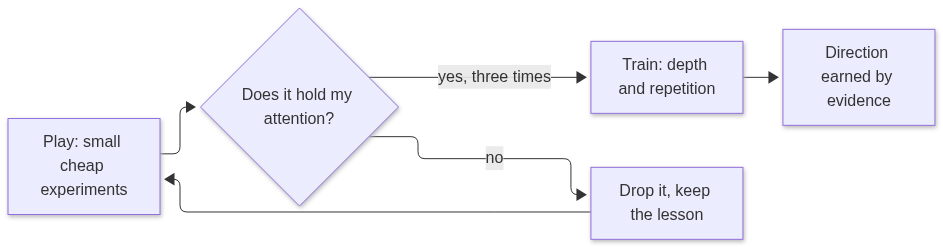
I'm not saying stay a child forever. At some point you take the thing that survived the experiments and you get serious about it: practice, depth, the boring hours. But the order matters. Serious first means you commit to a guess. Play first means you commit to evidence.
The mistake I see in smart people is skipping the first loop. They pick a direction at 18 because it sounds respectable, and spend ten years being very good at something they never tested.
How to run it on purpose
Keep the experiments small enough to finish in a weekend. Keep a list of what you did and what you noticed about yourself, not just about the thing. Watch for the project you keep returning to without being asked. That return is the data.
Then, when something earns your attention three times, stop playing at it and start training for it.
Next up: what to do once you know something, and why I think the most useful thing is to give it away. Part 7: "Give the Roadmap Away."
Non-Linear, Part 6. Part 5 was "Delicate Life, Unless You Focus." Part 7: "Give the Roadmap Away."
About the author
- Cloud and DevOps engineer working across AWS and Azure For GCP, with a background in automation and industrial computing. Interested in cybersecurity, fintech and model serving plus inference. Microsoft Certified Trainer and former AWS Community Builder.
Comments
Join the discussionNo comments yet. Be the first to comment.