Zero Trust Is a Life Philosophy
Part 3 of Non-Linear: notes from building across markets

There's a principle in modern security architecture called zero trust. The old model was a castle: hard walls outside, free movement inside. Once you were in the network, you were trusted. The new model throws that out. Zero trust says: never assume, always verify. Every request proves itself, every time, no matter where it comes from.
Somewhere between my security certifications and a few hard seasons in the Gulf, I realized zero trust isn't an IT architecture. It's the sanest way a person can move through the world.

Photo: WinonaSavingsBankVault by Jonathunder, CC BY-SA 3.0
The most dangerous sentence in any language
It's some version of: "It's fine, I know who this is."
Attackers know this sentence is the master key, and they build entire careers around making you say it. They don't hack systems first. They hack the moment you decide someone is legitimate. Once you say "it's fine, it's the bank" or "it's fine, it's a colleague," every wall you have silently opens. This is why social engineering beats technical hacking so often. Why break a lock when you can get yourself invited through the door?
Three rules that transfer from security to everything
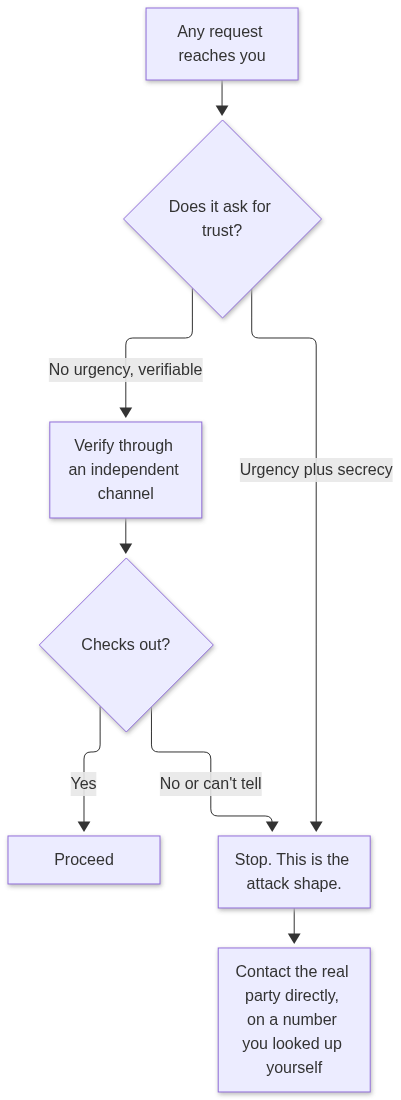
1. Verification is not rudeness. Somewhere along the way we decided that double-checking someone is an insult. It isn't. Your real bank will never be offended that you hung up and called the number on the back of your card. Your real colleague will never be offended that you confirmed a strange request through a second channel. Anyone who pressures you to skip verification is telling you something important about themselves. Legitimate institutions build their whole process around never needing you to break your rules. No real bank, government office, or employer will ever ask for the one-time code sent to your phone. That code is the keys to the building. It is yours alone, full stop.
2. Urgency is a tool, and mostly not yours. "Act now." "This expires." "Don't tell anyone yet." Genuine emergencies are rare. Manufactured urgency is daily, in scam calls and also in meetings, negotiations, and offers. Urgency exists to stop you from thinking, because thinking is where verification lives. My rule: the more urgent someone makes something feel, the slower I move. Real opportunities survive a night of sleep. Traps can't.
3. Context is not proof. Someone knowing your name, your employer, your account details, even your travel plans proves exactly one thing: information leaks. It does not prove they are who they claim. Half the data points a stranger could use to sound legitimate are things we hand out ourselves, on forms, in interviews, on social media. Treat inside knowledge as noise, not signal.
Zero trust is not zero warmth
Here's where people get it wrong. Zero trust sounds cold, like moving through life suspecting everyone. It's the opposite. It's what lets you be genuinely warm. When verification is a habit, trust becomes something you can afford to give generously, because you're giving it to people who earned it through a process you control. The paranoid person trusts no one and lives small. The naive person trusts everyone and gets hurt. The zero-trust person verifies fast, then trusts fully, and gets to live big.
The most trustworthy people in my life have never once rushed me past my own judgment. That's not a coincidence. It's basically the definition.
The one-line version
If I had to compress years of security work and some expensive education into one sentence, it's this: slow is safe, and safe is fast. The thirty seconds you spend verifying have never once cost anyone a real opportunity. They have saved countless people from losing everything they had.
Next: what actually survives when a market, a job, or a plan collapses. I did an inventory once, at a low point, and what I found rearranged how I think about wealth. Part 4: "Everything Earned Is Secured."
Non-Linear, Part 3. Part 2 was "Movement Is Not Progress." Part 4: "Everything Earned Is Secured."
About the author
- Cloud and DevOps engineer working across AWS and Azure For GCP, with a background in automation and industrial computing. Interested in cybersecurity, fintech and model serving plus inference. Microsoft Certified Trainer and former AWS Community Builder.
Comments
Join the discussionNo comments yet. Be the first to comment.