Attention Is the Highest Currency
Part 1 of Non-Linear: notes from building across markets

Here's something nobody told me when I started working across markets: money is not the scarcest thing you own. Neither is time, really. It's attention. Time keeps passing whether you show up or not. Attention is the part you actually spend.
I learned this the slow way, working from Tunis for clients in Canada, then moving to the Gulf, then sitting in rooms in Riyadh where everyone wanted something from me at once. Different time zones, different products, different urgency. The one constant was this: wherever my attention went, results followed. Wherever it leaked, nothing did, no matter how many hours I logged.

Photo: A Single Candle by sayamuncil, CC BY 2.0
Your brain is a monitoring system
In cloud engineering we obsess over observability. Dashboards, alerts, thresholds. And the first rule of a good alerting setup is brutal: if everything pages you, nothing does. Alert fatigue is real. An engineer drowning in noisy alerts will miss the one alert that matters, the 3 a.m. one that says the database is actually down.
Your life runs the same way. Every notification, every open tab, every "quick question" from a colleague is an alert competing for the same on-call engineer: you. Most of them are noise. A few are signal. The whole game is telling them apart before the pager goes off.
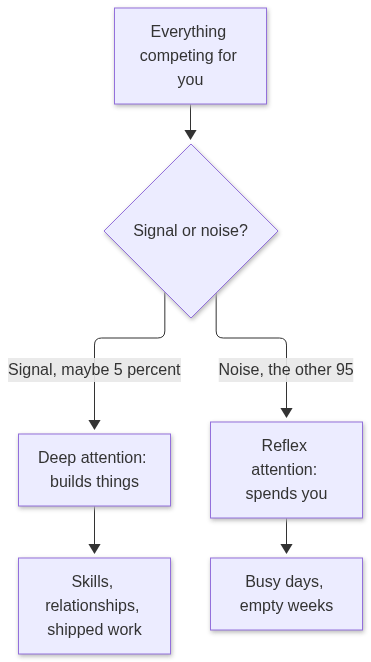
Look at that diagram and be honest about which branch your average day takes.
Attention compounds like money does
People talk about compound interest. Attention compounds harder. One focused year on a hard skill puts you in a room you couldn't enter before. Ten focused hours a week on a side product, kept up for two years, becomes a company or at least a story that opens doors. I watched people around me in Doha earn similar salaries and end up in completely different places, and the divider was never intelligence. It was what they paid attention to after 6 p.m.
The reverse compounds too. A year of scattered attention doesn't give you a neutral year. It gives you a year of practiced distraction. You get good at whatever you repeat, including scattering.
Three rules I actually use
- Budget it like money. Every morning I decide where the day's attention goes before the world decides for me. Two or three things, written down. Everything else is a withdrawal I didn't approve.
- Silence the noise tier. Most alerts in my life are now muted, batched, or gone. Not because I'm rude. Because the signal deserves a clear channel.
- Audit weekly. Once a week I ask: what ate my attention, and what did it build? If the answer is "nothing" three weeks in a row, that source gets cut.
The uncomfortable part
Here's the thing nobody likes hearing: you already spend your attention exactly on what you value. Not what you say you value. What you actually value. Your screen time report is a more honest biography than your resume.
That stung when I first sat with it. But it's also the good news. Attention is the one currency you can redirect starting today, no permission needed, no visa, no offer letter, no market conditions.
Next in this series: why moving fast feels like winning, and why it usually isn't. We'll talk about the difference between movement and progress, and the year I confused one for the other.
Non-Linear, Part 1. These are field notes from an engineer's path across markets, Tunis to Canada to the Gulf and back. Part 2: "Movement Is Not Progress."
About the author
- Cloud and DevOps engineer working across AWS and Azure For GCP, with a background in automation and industrial computing. Interested in cybersecurity, fintech and model serving plus inference. Microsoft Certified Trainer and former AWS Community Builder.
Comments
Join the discussionNo comments yet. Be the first to comment.