Movement Is Not Progress
Part 2 of Non-Linear: notes from building across markets

A few years ago I looked at my own life and saw a highlight reel of movement. New countries. New offers. New titles, new stacks, new rooms with important people in them. Tunis, then remote work for Canada, then Doha, then Riyadh. If you scrolled my timeline it looked like a rocket.
Then one quiet evening I asked a dumber question: where am I actually going? And the honest answer was uncomfortable. Lots of distance traveled. Not much displacement.
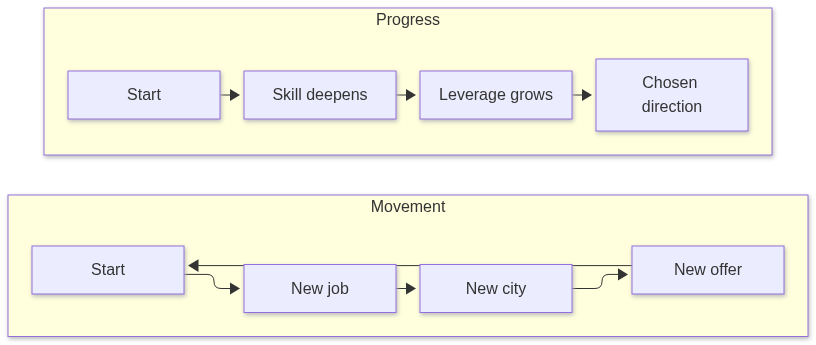
Physics has a distinction I wish someone had tattooed on my forearm at twenty. Distance is how much ground you covered. Displacement is how far you ended up from where you started, in a direction that counts. A runner sprinting laps around a track racks up huge distance and finishes exactly where they began. Tired, sweaty, and in the same place.
The market rewards motion, and that's the trap
Every market I entered had its own treadmill, and every treadmill paid in the same currency: the feeling of advancement. A shinier offer. A bigger city. A more impressive logo on the badge. Each one felt like progress because movement is loud and progress is quiet. Movement comes with announcements. Progress mostly comes with Tuesday afternoons where you got slightly better at something nobody clapped for.

Photo: Hamster wheel by tagawa, CC BY 2.0
I don't regret the motion. The motion taught me things you can't learn standing still: how different markets price the same skill, how fast trust is built and lost across cultures, how to land in a new place and become useful within weeks. But I eventually noticed the people I respected most weren't the ones who moved the most. They were the ones who moved on purpose. Every step pointed somewhere they had chosen in advance.
Speed is a number. Velocity is a direction.
Here's the engineer's version. Speed is a scalar: how fast. Velocity is a vector: how fast, and toward what. You can have enormous speed and near-zero useful velocity if the direction keeps changing. Twenty percent effort in five directions loses to full effort in one direction, every single time, and it isn't close.
The practical question became very simple, and I now ask it about everything: does this move add displacement, or only distance?
- A new certification that stacks on a chosen path? Displacement.
- A new certification because a shiny one appeared? Distance.
- A move to a city where your specific craft compounds? Displacement.
- A move because the last city got boring? Distance.
How to pick a north star when you genuinely don't know
Fair pushback: "Easy to say. What if I don't know my direction yet?" Then your current direction is finding the direction, and you should judge moves against that. Exploration is a legitimate vector, as long as you admit that's what you're doing and set a date to stop exploring and start compounding. Wandering is only a strategy when it's scheduled.
My own path bent through automation, cloud, security, fintech, and eventually toward model serving and inference. From the outside it looks scattered. From the inside, each bend was a search query: is this the thing? The searching was the progress. The moment I treat a bend as the destination instead of the search, I'm back to running laps.
The test I run now
Before any big move, I write one sentence: "After this, I will be able to ___ that I cannot do today." If I can't finish that sentence with something real, it's movement. Sometimes I still do it. Life isn't a spreadsheet and some movement is just living. But I do it knowing what it is.
Next: the lesson that cost the most and travels the furthest. What cybersecurity taught me about people, and why "trust but verify" is too generous. Part 3: "Zero Trust Is a Life Philosophy."
Non-Linear, Part 2. Part 1 was "Attention Is the Highest Currency." Part 3: "Zero Trust Is a Life Philosophy."
About the author
- Cloud and DevOps engineer working across AWS and Azure For GCP, with a background in automation and industrial computing. Interested in cybersecurity, fintech and model serving plus inference. Microsoft Certified Trainer and former AWS Community Builder.
Comments
Join the discussionNo comments yet. Be the first to comment.